Former UC Irvine All-American Making A Difference
November 03, 2020 | Men's Water Polo, Features
Story By Olivia Phelps for ucirvinesports.com
Thirteen players, every four years.
That is the reality for an aspiring Olympian in the sport of men's water polo.
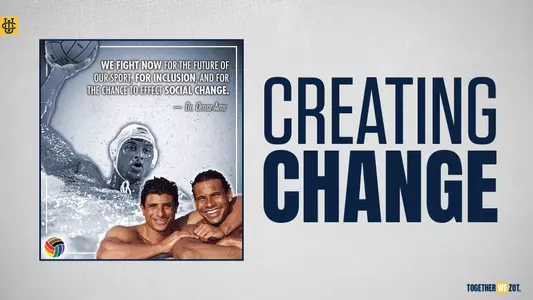
UC Irvine alum Omar Amr faced another reality that was personal as he chased his dream of Olympic glory – no African American had ever made a United States Olympic roster, and the sport's culture reflected it.
"If you look at any game," he said, "any swim meet, there is just no inclusion within the sport."
A target of racism in the pool before and during his time with the U.S. national team, Amr knew something had to change.
UNITED WE STAND
On June 2, in the wake of the brutal murder of George Floyd, USPOC CEO Sarah Hirshland wrote in an open letter to Team USA athletes, "The USOPC stands with those who demand equality and we want to work in pursuit of that goal."
On the same day, USA Water Polo posted a statement on social media from CEO Christopher Ramsey that said, "For those of us in the water polo community, recent events should further strengthen our dedication to diversity and inclusion."
These sentiments did not sit well with Amr, so he reached out to the governing body.
"I took [the statements] as a slap in the face, because Genai [Kerr] and I are the only two African Americans to compete in the Olympics," said Amr.
When USA Water Polo asked what it could do to help make their statements true, Amr asked for four things: to create a minority-based research program, to invest funds in education, to implement a zero-tolerance policy and to provide education for coaches, players and referees.
"I didn't want to be another angry dark guy going after revenge, I just wanted change," he said.
As the weeks passed and Amr heard nothing from USA Water Polo, Amr continued to work on a project of his own with former teammates, friends and colleagues. It was an idea that Amr had thought about for years, a place for BIPOC (black, indigenous, and people of color) athletes, and any athlete of any sexual orientation to come forward and feel safe. Amr had set out to create something similar in the past, but it had never been the right time.
Not even when he and teammate Kerr, also a UCI All-American, made history in 2004.
THE FIRSTS
Amr's road to competing at the 2004 Olympics looked a little bit like this: attend classes at Harvard medical school during the week, catch the red eye to Southern California to train with the national team over the weekend, take the red eye back to Boston, repeat.
"I had gotten to this point training for 2004, where the only way that I was going to be ok with it mentally, if I didn't make the team, was if I had done everything possible," he said. "If I didn't do everything possible, I knew I would leave frustrated."
Amr did the impossible, and when he made the roster to compete in Athens with Team USA, he and teammate Kerr became the first African Americans to represent the country in the sport. The duo made history and laid groundwork for generations of BIPOC athletes to come, but change was slow to follow.
Even after being touted as the first African American to compete, little light was shed on the discrimination he suffered within the sport.
After finishing his schooling and retiring from competing, Amr was still dedicated to addressing the injustices he had faced during his time as an athlete, so the Anteater alum served as the national women's team doctor where he also had the opportunity to mentor athletes while practicing medicine. As someone who is obsessively driven by setting and achieving goals, elevating the next generation of minority athletes and coaches within the sport was always at the top of his list.
ELEVATING MINORITIES
While on the East Coast as a student, Amr coached water polo at Harvard and later at MIT. Knowing he would be leaving after finishing school, MIT asked Amr to hire his replacement.
Amr immediately thought of his friend and colleague Felix Mercado who was in his 11th year coaching at Ransom Everglades School in Miami, Fla.
Mercado, a Puerto Rican coach he had worked countless camps with in the past, hesitated at first, but agreed to take the job at Amr's request.
"My whole life, I've tried to get minorities involved in our sport in high-profile situations like this" said Amr. "I literally told him, I need you to do this."
THE ALLIANCE
Now the GME US Director and Clinical ED US Director at St. Joseph's Medical Center Stockton in Stockton, Calif., Amr is still driven by his goal of creating a more inclusive environment within the sport in which he represented his country on the greatest stage. When he articulated four objectives for USA Water Polo to implement earlier this year, he knew he could do more. As the country experienced a social revolution, Amr founded the Alliance for Diversity and Equity in Water Polo (ADEWP) to begin implementing permanent change.
"The goal initially was to create a safe space for BIPOC athletes, and any athlete of any sexual orientation to come forward and feel safe," he said.
With Amr, Mercado, Kerr and John Abdu, who also played at UC Irvine and is the Chief High Performance Operator for USA Water Polo, as the Alliance's first four members, the organization set out to foster greater inclusivity in the sport. Though he felt strongly about the mission and vision for the Alliance, Amr never dreamed it would evolve into what it is today.
"We went from a safe place to talk, to filing to incorporate as a nonprofit," said Amr. "Athletes were afraid to tell their stories five, 10, 15 years ago, but times are different now."
The first meeting took place over Zoom with about 12 people who came together to share stories of their experiences within the sport.
"It was therapeutic," said Amr.
Despite a successful first "meeting" Amr worried if there would be enough interest to host a second call. Much to his chagrin, word of the Alliance spread like wildfire, and people jumped at the opportunity to participate. With over 1,000 members now from all over the country, the Alliance has formed an official board and is organized into four major divisions: athlete mentorship, education, research and social media.
"I'd be lying if I told you I thought [the Alliance] was going to grow like this," said Amr. "But, the country was ready this year, more than any other year, to hear this."
Amr never imagined he'd start a 501(c)(3), but is elated that the winds of change are beginning to blow. The Alliance includes athletes from all over the country including student-athletes from universities like Yale and Indiana, and boasts a diverse group of people who are all passionate about changing the sport's culture.
Some of the Alliance's objectives include water-safety programs in inner-cities, educating the youth on inclusion and equity and Amr's personal passion, athlete mentorship.
"I didn't have that [BIPOC] mentor, back in the '90s I was the only one. There were speckles here and there, but no one was competing at that high-level for very long."
Amr is determined to change that for the next generation and is thrilled that his vision for mentorship was met with such enthusiasm at the Alliance. He hopes to facilitate a program that encourages youth to set goals both in and out of sport. As an emergency room physician, Amr hopes to show the younger BIPOC generation that they too can explore a number of fulfilling careers outside of the pool.
When working camps and clinics as an athlete and coach, Amr would often ask young players what they wanted to be when they grew up.
"Every single one of them would say professional athlete. No one would say lawyer, doctor, engineer…
"I want these kids to know they could be something else [too]."
THE FUTURE
Thirteen players every four years.
When asked if USA Water Polo is on the track to make that elite group more diverse, Amr said, "The short answer is no. But I think the alliance, and I think in this political divide, we're creating awareness which is the first step.
"I'm hopeful that the fight will continue with these younger athletes long after I step away from the Alliance. Hopefully, someday, it will be more inclusive."
Thirteen players, every four years.
That is the reality for an aspiring Olympian in the sport of men's water polo.
UC Irvine alum Omar Amr faced another reality that was personal as he chased his dream of Olympic glory – no African American had ever made a United States Olympic roster, and the sport's culture reflected it.
"If you look at any game," he said, "any swim meet, there is just no inclusion within the sport."
A target of racism in the pool before and during his time with the U.S. national team, Amr knew something had to change.
UNITED WE STAND
On June 2, in the wake of the brutal murder of George Floyd, USPOC CEO Sarah Hirshland wrote in an open letter to Team USA athletes, "The USOPC stands with those who demand equality and we want to work in pursuit of that goal."
On the same day, USA Water Polo posted a statement on social media from CEO Christopher Ramsey that said, "For those of us in the water polo community, recent events should further strengthen our dedication to diversity and inclusion."
These sentiments did not sit well with Amr, so he reached out to the governing body.
"I took [the statements] as a slap in the face, because Genai [Kerr] and I are the only two African Americans to compete in the Olympics," said Amr.
When USA Water Polo asked what it could do to help make their statements true, Amr asked for four things: to create a minority-based research program, to invest funds in education, to implement a zero-tolerance policy and to provide education for coaches, players and referees.
"I didn't want to be another angry dark guy going after revenge, I just wanted change," he said.
As the weeks passed and Amr heard nothing from USA Water Polo, Amr continued to work on a project of his own with former teammates, friends and colleagues. It was an idea that Amr had thought about for years, a place for BIPOC (black, indigenous, and people of color) athletes, and any athlete of any sexual orientation to come forward and feel safe. Amr had set out to create something similar in the past, but it had never been the right time.
Not even when he and teammate Kerr, also a UCI All-American, made history in 2004.
THE FIRSTS
Amr's road to competing at the 2004 Olympics looked a little bit like this: attend classes at Harvard medical school during the week, catch the red eye to Southern California to train with the national team over the weekend, take the red eye back to Boston, repeat.
"I had gotten to this point training for 2004, where the only way that I was going to be ok with it mentally, if I didn't make the team, was if I had done everything possible," he said. "If I didn't do everything possible, I knew I would leave frustrated."
Amr did the impossible, and when he made the roster to compete in Athens with Team USA, he and teammate Kerr became the first African Americans to represent the country in the sport. The duo made history and laid groundwork for generations of BIPOC athletes to come, but change was slow to follow.
Even after being touted as the first African American to compete, little light was shed on the discrimination he suffered within the sport.
After finishing his schooling and retiring from competing, Amr was still dedicated to addressing the injustices he had faced during his time as an athlete, so the Anteater alum served as the national women's team doctor where he also had the opportunity to mentor athletes while practicing medicine. As someone who is obsessively driven by setting and achieving goals, elevating the next generation of minority athletes and coaches within the sport was always at the top of his list.
ELEVATING MINORITIES
While on the East Coast as a student, Amr coached water polo at Harvard and later at MIT. Knowing he would be leaving after finishing school, MIT asked Amr to hire his replacement.
Amr immediately thought of his friend and colleague Felix Mercado who was in his 11th year coaching at Ransom Everglades School in Miami, Fla.
Mercado, a Puerto Rican coach he had worked countless camps with in the past, hesitated at first, but agreed to take the job at Amr's request.
"My whole life, I've tried to get minorities involved in our sport in high-profile situations like this" said Amr. "I literally told him, I need you to do this."
THE ALLIANCE
Now the GME US Director and Clinical ED US Director at St. Joseph's Medical Center Stockton in Stockton, Calif., Amr is still driven by his goal of creating a more inclusive environment within the sport in which he represented his country on the greatest stage. When he articulated four objectives for USA Water Polo to implement earlier this year, he knew he could do more. As the country experienced a social revolution, Amr founded the Alliance for Diversity and Equity in Water Polo (ADEWP) to begin implementing permanent change.
"The goal initially was to create a safe space for BIPOC athletes, and any athlete of any sexual orientation to come forward and feel safe," he said.
With Amr, Mercado, Kerr and John Abdu, who also played at UC Irvine and is the Chief High Performance Operator for USA Water Polo, as the Alliance's first four members, the organization set out to foster greater inclusivity in the sport. Though he felt strongly about the mission and vision for the Alliance, Amr never dreamed it would evolve into what it is today.
"We went from a safe place to talk, to filing to incorporate as a nonprofit," said Amr. "Athletes were afraid to tell their stories five, 10, 15 years ago, but times are different now."
The first meeting took place over Zoom with about 12 people who came together to share stories of their experiences within the sport.
"It was therapeutic," said Amr.
Despite a successful first "meeting" Amr worried if there would be enough interest to host a second call. Much to his chagrin, word of the Alliance spread like wildfire, and people jumped at the opportunity to participate. With over 1,000 members now from all over the country, the Alliance has formed an official board and is organized into four major divisions: athlete mentorship, education, research and social media.
"I'd be lying if I told you I thought [the Alliance] was going to grow like this," said Amr. "But, the country was ready this year, more than any other year, to hear this."
Amr never imagined he'd start a 501(c)(3), but is elated that the winds of change are beginning to blow. The Alliance includes athletes from all over the country including student-athletes from universities like Yale and Indiana, and boasts a diverse group of people who are all passionate about changing the sport's culture.
Some of the Alliance's objectives include water-safety programs in inner-cities, educating the youth on inclusion and equity and Amr's personal passion, athlete mentorship.
"I didn't have that [BIPOC] mentor, back in the '90s I was the only one. There were speckles here and there, but no one was competing at that high-level for very long."
Amr is determined to change that for the next generation and is thrilled that his vision for mentorship was met with such enthusiasm at the Alliance. He hopes to facilitate a program that encourages youth to set goals both in and out of sport. As an emergency room physician, Amr hopes to show the younger BIPOC generation that they too can explore a number of fulfilling careers outside of the pool.
When working camps and clinics as an athlete and coach, Amr would often ask young players what they wanted to be when they grew up.
"Every single one of them would say professional athlete. No one would say lawyer, doctor, engineer…
"I want these kids to know they could be something else [too]."
THE FUTURE
Thirteen players every four years.
When asked if USA Water Polo is on the track to make that elite group more diverse, Amr said, "The short answer is no. But I think the alliance, and I think in this political divide, we're creating awareness which is the first step.
"I'm hopeful that the fight will continue with these younger athletes long after I step away from the Alliance. Hopefully, someday, it will be more inclusive."


Monday, April 20
Monday, April 20
Thursday, February 26
Friday, November 21