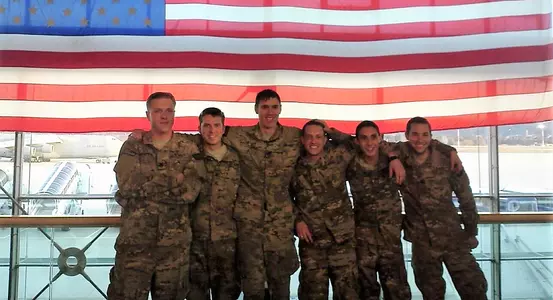
A Veteran In Our Midst
November 11, 2018 | Men's Volleyball, Features
IRVINE, Calif. -- Not every athletic department has a veteran in its midst, but UC Irvine is lucky to have men's volleyball player Andre Castro, who served in the Navy from 2010-2016.
"Andre's experience in the military cultivated a deep appreciation for service and support within a team environment," men's volleyball head coach David Kniffin said. "He has a keen ability and willingness to follow leadership. He operates in a mission-first mindset. I am grateful to Andre for these qualities and I am grateful to the Unites States military for their investment in him. Andre makes our team, University and country better."
Andre, a social ecology major and member of the Campuswide Honors Program, shared how his time in the Navy shaped his life and how it continues to infuse lessons learned into his time as an Anteater.
Did your work ethic change while you were in the Navy?
Absolutely. I joined for that specific reason. I always had a drive to succeed, but I didn't have the discipline or commitment to have an effective work ethic. The Navy restructured the foundation of my work ethic. It created a foundation that I believe has supported my drive in a way that allows me to flourish. I would have never been able to survive a DI environment even if I would have had the skill when I was 18. Commitment to process, or the mission, and how to outline a strategy using analytic tools is something, and possibly the most grateful habit, that deals with work ethic. I honed and developed those skills through my time in the Navy.
Was volleyball part of your time in the military?
Playing volleyball was something that I never thought would be more than just a hobby although I always wanted to go to the Olympics, without really knowing what that meant. It was just another thing that I did because it was fun during my first few years of service. I found open gyms and made friends in the communities that were already established in Pensacola, FL, Baltimore, and Afghanistan. So I played when there were open gyms, but I wasn't specifically training for volleyball. In 2014 my contract was two years away from ending and I had to decide what my next step was. This was a few months after I returned to Afghanistan working in support of Special Forces, the path I wanted to pursue. There were set timelines and I really only had one shot, so in case I didn't make it, my contingency plan was to play volleyball in college as I wasn't going to continue in my Naval Rate (job) as a civilian. I trained as any person wanting to become the intelligence support operator on a Navy SEAL Team would. I would lift in the mornings, swim in the afternoons and play basketball for cardio, then go to volleyball practice. I was playing for the University of Maryland, Baltimore County's Club Volleyball team at the time, and I'd play in local tournaments. I played around with the idea of playing college ball and they supported it seeing my growth for the past year.
This was while I was stationed at Ft. Meade, which was basically like working a 9-5 white collar job in a military uniform. I had no problems working out and developing my skills through playing and practicing with the club. However our coach was one of my teammates with some of the NCAA women's volleyball players coming by to help occasionally. This was tremendously helpful as this was the first time I learned anything about passing.
I fell into some trouble which disqualified me for working for the Special Forces. I ended up serving some restriction time, which I would equate to a very lax prison sentence, for a few months. I had been dealing with the struggles of adjusting back to a normal life after 9 months in Afghanistan, which lead to depression and anxiety. Moving from a fast-paced, life or death, where everything-that-you-do-matters environment to a very slow and bureaucratic process, posed a difficult re-adjustment. The long punishment term that was imposed on me while dealing with my mental health concerns was devastating and cut me off from the one source of drive which I had - volleyball.
From this low point, I had to figure out a path forward. Otherwise the repercussions could have become life threatening.
This is the event in my life that has allowed me to become the most resilient and lead me to the exploration of self-care and the connection between mind, body and spirit. I have recreated myself and laid the foundations that allow me to problem solve through my emotions, feelings, thoughts and actions and continue to move forward in life. It's more than just the mission, it's about enjoying the process to achieving your goals. I now live every single day in life with the framework," Is what I'm doing going to ultimately lead to my happiness?" I don't mean this to be that there will not be pain and struggle in my life, as I hit the lowest point in my life to get to that point. But is this pain and struggle worth the effort. Can I get on board with what I'm doing because it is essential in becoming who I want to be and what makes me the happiest at the end of the day. I know Kniff has been pushing this love for process as the focus for this year, and I absolutely love the framework, because this is what I literally live for.
So, after my time served was up, I had to cling to plan B, which was playing college volleyball. It was hard, but volleyball was the one thing I could lean on to keep me sane. It was my drug and what I focused on, my light at the end of the tunnel. When I transferred to a ship, it was hard to find the space to make it work. I knew I had to digest as much volleyball as I could, so if I wasn't playing I had to be thinking about it. That is all I wanted to do, so it was the sole focus apart from my job. I would set every single night in our berthing (the living space where all our beds were while the lights were off. I'd run footwork drills on the non-skid. We'd have a net set up in our hangar, so I taught people how to play to up the level of competition. But when I wasn't doing this I read. I ordered Arte Sellinger's "Power Volleyball." It was this beat up book from the 80's. It looked like something my grandfather had held onto for too long. But I ate it up and just tried to learn as much as possible. I'd ask my friend to email me USB's with matches so I could learn.
That was probably the toughest time away from the game, because it was the most time away. But I was fortunate enough to have people who supported my decisions and the process. At this time I was really obsessed with this conception of greatness and why someone was considered a "Great" in any capacity. And what I found was that they put in the work and found a way to work around the obstacles or constraints, so that when they could perform without the obstacles or constraints, it was easy for them. We watched this movie "Free Solo" this past week as a team, and I think this saying captures it best: "Low Risk, High Consequence." The risk of failing is low, but if they fail they lose, and sometimes it's more than a game. And, I guess, that really defines how I approached volleyball because at one point finding happiness was so important, because it was life or death for me. Volleyball was what brought me happiness. So it didn't matter how tough it was. It's just what I did.
How does the team setting in the military compare to the team setting on a volleyball team?
Kniff does a great job of laying this out for us. We are an organization that is allowed to function because of the administration around us, but we have to be self-sustaining. They allow us to play volleyball, but we've gotta get the job done. We have an objective measure to achieve which is beyond us as individuals, but all of us play a mission critical role to making it happen. In the military it's much in the same. There are structures in place that lay the guidelines that frame what needs to be done and what the overarching mission is, but that mission is broken down to many levels and processes which enable the mission to make it to the front lines, or the "tip of the spear". The seven or so tributes we put out on the court on game night are the tip of the spear for our team, but that is just the tip. Everyone on the team and all the people who support us are mission critical components that make up the shaft and tail of the spear. Without any of that, the spear wouldn't be able to hit it's mark.
The biggest difference is the reason why you do it. One is to win national championships, the other one is to safeguard the lives of those who put their lives in danger. It's minimizing risk of someone dying. On the court and the objectives of the team require the same level of focus, precision, planning, buy in and commitment, just with a different, but equally challenging objective.
How do the leadership qualities you learned in the Navy help you as a player/teammate?
A title doesn't make you a leader. The melting pot that is the Navy is a reflection of the diversity of the U.S.A. Everyone has a different understanding, and presents and solves problems in different ways. Sometimes this jives with how you understand, and sometimes it doesn't. What makes a leader is not what is on someone's chest, but the actions that one takes.
You have to look out for your team. You are one unit and the survival of that unit is dependent upon the people within the unit. You have to get to know your team, and how to best utilize them for the mission. We talk about the phalanx, and how you look after the guy next to you. The way you do this is by leveraging your strengths as everyone's strengths reinforce one another to make a strong unit, protecting weak points.
You have to lead through accountability. Talking about doing something and not following through is the first way to lose your team's trust. Taking action, setting objective standards, and outlining the consequences are key to the foundation of military operations. When you hold to these principles results are produced. When you diverge from these principle there is a failure in the system. We were trained to learn how to do this in the military. Within volleyball this is what we are training for. These are many of the principles Coch Kniffin works to instill in us.
The mission comes first. Ultimately all of the things before culminate in the objective or the mission. You have accountability, develop trust, and take action to accomplish the mission. You must learn to define what the mission is, why it is important, and what the best way to approach it is given what you have.
The framework I lived in while in the military is extremely similar to the framework Coach Kniffin presents to us in winning a national championship. Having had experience with the structure allows me to be a conduit to the team, in that I can provide a different perspective, that may be more relatable. I often work as a translator.
What do you most admire about those who have served and those who continue to serve?
The sacrifices that one makes even if they are not aware of what they are giving up. Even if you enjoy serving you still have to learn to adapt every time you move. It is an unconventional lifestyle for many, and they continue to do it regardless of the reason. I didn't always agree with our missions or why we did what we did, but nonetheless you look beyond yourself, because the reason is beyond you.
Do you do anything special on Veteran's Day?
I don't typically think about my experiences, but it gives me a day to reflect on my service, what it meant to me, and what it means to me now. I really find myself being grateful for what my time in the service has provided for me and how it has shaped me to this day.
I enjoy going on social media and seeing the great things that my brothers and sisters are doing. Right now, I think my service is still too close to truly realize how important it was to me becoming who I am, but I would like to do more for my fellow Veterans who have not been as fortunate as myself, which is something I've become more aware of lately.


UCI would like to thank Andre and all of those who have served and who continue to serve on Veteran's Day.