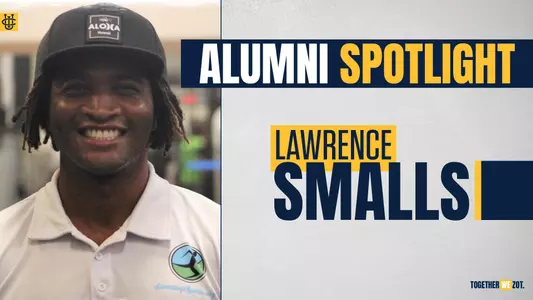
Alumni Spotlight: Lawrence Smalls
February 08, 2021 | Men's Soccer
The Anteater soccer programs from the onset were competitive and producing top-tier talent, but it took a special talent to break through and become the first to make waves on the professional level. That talent was Lawrence Smalls, a Southern California native that paved the way onto the Major League Soccer scene, and has continued to use his skills to extend soccer reaches to all ages and walks of life.
Coming out of Pasadena, the promising midfielder was thriving at his many club teams such as Santa Anita Soccer Club and California Flyers. During his 1998 senior season of high school, colleges like Cal, Saint Mary's, and Notre Dame were options for him, but he took a liking to UC Irvine and the staff there.
"We frequented Orange County every other weekend for Coast Soccer League. I liked the environment down in Orange County," Smalls jogged his memory back to then when he could remember not a whole lot around University and Jamboree and East of the 405. "Coach Kuntz had seen me a couple times through ODP and we connected and got UC Irvine on my radar. They ended up being my top pick. I liked George and Chris Volk, they were friendly and awesome. Also, UCI was close enough to home where parents and friends could come watch, but far enough to where I was able to move out, kind of best of both worlds.
Smalls was getting acclimated quickly having befriended some of his fellow freshman classmates from recruiting trips and picking up on the vibe that the upperclassmen were dishing out. He and fellow freshman Sean Gesell found their way into the lineup that first year despite a strong returning group of seniors.
"It was a good learning curve and I had a pretty decent first season playing with all the experience around me. I got a nice confidence booster being voted Freshman of the Year by the team and coaches."
Smalls' big highlight that year was a game-winning goal in double overtime to drop No. 8 San Diego. He finished with one of his best statistical seasons including a career-high four goals in his freshman campaign. He added to it with three more goals as a sophomore, and a career high of 11 points in his junior year where he scored First Team All-Big West honors.
In the classroom, Smalls was determined to make his mark as well. He didn't have a concrete plan, but knew professional soccer was not a high-percentage shot for anyone from UC Irvine to this point so he was preparing for life after soccer.
"I went in undecided and undeclared thinking I might want to go into law school. Initially, I wanted to go into architecture. I had lengthy conversations with coach Kuntz over that because I really wanted to be an architect."
No programs for architecture at the time found Smalls searching down other avenues – environmental analysis, design, and social ecology. He went down the law school route that intrigued him through social ecology and criminology.
"I went for it and it was pretty difficult. I don't think I was up for that stress level. I declared then for general social ecology and took classes for criminology, psychology, and social behavior. I was interested in working with kids, at-risk kids, youth intervention programs, and the prison systems."
Smalls' coursework included street gangs in Los Angeles and doing field work like ride-alongs. He took on an internship his senior year at the Bureau of Prisons in downtown Long Beach at a drug treatment program.
"I was monitoring clients and helping with paperwork. I was just being prepared if I wasn't going to play professionally that I'd have something to fall back on."
Smalls' senior season didn't hit his expectations on the field, statistically, finishing up his career without a goal that season. His career numbers told a successful story with 10 goals, 11 assists, and 31 points while starting 68 of the 75 matches he played in. His most-notable moment may have come from the sidelines that season.
"We had up-and-down seasons, and starting pulling it together my junior year. We felt we should have made the tournament. Senior year, I didn't reach my expectations and didn't deliver like I wanted to, but we got to play against teams like UCLA who was led by Sigi Schmidt before he went off to LA Galaxy and he saw me."
A significant moment for Smalls who had a down year to finish off his collegiate career. Schmidt, as he mentioned, was commandeering UCLA to an historic run of success, and would soon get plucked by the professional ranks at LA Galaxy. Smalls was on Schmidt's radar in high school, but said he'd "get too hot" which Smalls admits he drew the red card a time or two.
Now with both beyond their collegiate careers, it was the perfect time to link up and make some magic happen. LA Galaxy invited him to combines in the winter of 2001 in between work and his plans to graduate later in 2002. Then suddenly, he got the call in the unlikeliest of places.
"Coach Kuntz and a lot of other people called me saying you've been drafted, and I was working in LA at the time. I was doing a side-gig that Saul Wolf's sister got me into doing some modeling for Tilly's. The guys would make fun of me because a big photo of me would be up at the Tilly's in Huntington Beach and Orange County. That's what I was doing up at the LA Convention Center when I got the call and messages. I was like whoa!"
The part-time model was now the poster child for Anteaters in professional soccer. Selected by the LA Galaxy, the 21-year-old was training with the defending MLS Cup champions alongside big names like Cobi Jones, Landon Donovan, Frankie Hejduk, and Alexi Lalas.
"I was commuting from UCI going from early morning training at the Rose Bowl and then back to Irvine to take afternoon classes that senior year semester. Sigi told me since I'm so close to finishing school, just finish and we'll continue to work and find avenues and come train when you can."
Training with Landon Donovan by day and studying street gangs by the afternoon. It all paid off by winter 2003 when he earn his diploma, and now he was able to focus on training. The Galaxy had an unofficial farm program affiliated with Orange County Blue Star coached by future U.S. National Team coach, Jurgen Klinsmann, which Smalls would flourish under for two seasons. The reserve league was short-lived as the MLS would do away with it in 2005, but Smalls' work regiment made his professional soccer career seem like a side gig.
"While I was playing professionally, I signed on with UCI as a third assistant part-time working, helping the students, training, and possibly get in a master's program. I traveled with those teams, the Brad Evans and Kevin Santoras, and did that for three years. I was also working part-time in Pasadena helping coach, helping at-risk youth in a program at the local unified school district, like a summer program that helped me get a taste of working in those conditions. Mid-2000s I also traveled at times after Nike offered a sponsorship to be a brand ambassador to work community events, coaching tutorials, skills sessions. We'd go around to U.S. National Team games, Nike stores, and we'd talk to kids and show them skills demonstrations and small tournaments. It really helped me connect with a lot of people in my life."
By 2006, Smalls' contract with Nike had ended on top of the end of the reserve league. He was questioning what the next move would be – to go deeper into his pro career pursuit or see what else he could do.
"I was already at a point where I was going on 26 and I needed to start thinking about the next 30 years. There was an opportunity to go to Toronto for the expansion team, but mentally I think I was already exhausted being challenged physical and mentally more than I ever had. It was awesome, I just wish there were more teams at that time, the league was still developing not like the 20 or so clubs they have now."
Smalls would find himself in Hawai'i of all places. First landing there in 2005 helping coach Kuntz with soccer camps and help coaching license courses. He would return a few times and kept thinking he had to find a way to get back.
"I met some people and before you know it, a private K-12 school was looking to start an after-school soccer program. They had coaches on the grounds, but wanted to get someone with experience with clubs and organizations."
Smalls knew he probably wasn't the most qualified, but felt the drive and inspiration. He was offered a full-time position, something rare according to Smalls, especially in Hawai'i, and by the age of 27, he had nothing to lose. Maybe he stuck it out for a month or a year and could jump to the next excursion. So he took the leap.
Early on, he was working with the school's club, Lasered On Academy, when Chelsea Football Club came calling from England to connect for a global outreach program bringing in coaches to help run camps and establish a good relationship with them. The school was progressing very well, but Smalls felt like he was hitting a ceiling.
"What I wanted to do was extend the community outreach program to all public schools and get out there. I was handling administration and coaching at the academy and the club so I felt that if I started my own after school program, strictly after school, working with kids from kindergarten through sixth grade, I can have more flexibility and impact a wider community."
His plans were already in motion for his own nonprofit, Advanced Sports Academy, which hit the ground in 2012 with the goal of educating students on healthy lifestyle habits and soccer as the pilot sport. Soccer and physical education programs for the last eight years have continued to impact the youth in the area. He started with three schools until the largest school out there contacted him looking for a program.
"Lucky for me I created a website. They happened to see it, we had an interview, and it helped open doors on private school levels. Word got around pretty fast, and we've grown to 18 schools now."
Advanced Sports Academy has thrived under his leadership as president. Managing day-to-day operations for Smalls consists of adding on support from various small grants and individual contributions to big players in the community like Nestle, Nan Inc., and the State of Hawai'i to sustain operations and volunteers. Even there, he's found a way to extend his reach to a second organization that he's in charge of.
"Two or three years ago, I ran into someone dropping off flyers for a soccer camp who was president for AYSO United. They had wanted me to come on board as the Director of Coaching for the club in a limited role knowing Advanced Sports Academy was my focus. So I agreed to that for two years as the DOC until this past year switching roles to become the president. In a sense, that kind of freed up my time to focus on the nonprofit, but that's where I stand, President of AYSO United Hawai'i chapter as well as Advanced Sports Academy."
Dual presidencies sounds like twice the work in most cases. In Smalls' case, he's using it to his favor out in Hawai'i. He's able to reach out to coaches and kids from clubs and schools all over with the island.
"I feel the impact we're giving is greater. It's not just for one club or one school, we're trying to deliver a good professional service after school to kids across the island."
Smalls keeps his academy and AYSO United independent, not tying them together. He just wants to give as much as he can to as many people as he can while also giving back.
"I like to give back and help AYSO any way I can. I started with them in Pasadena and they've been a longtime organization that's worked with millions of kids. It felt it was good synergy to get back involved with them. I'm a resource for other organizations including Chelsea."
He always brings it back to where it started in Southern California where his friends are family are and that includes UC Irvine. Smalls comes back to the University for the occasional drive-by a couple times a year checking in in the offices to see staff and advisors.
"My family and all of my friends are still in Southern California. I still visit once or twice a year. I'm always down in Orange County. I used to go check in the offices and see Paul Hope, the academic advisors, marketing, I try and stay connected. It's hard being here in Hawai'i and not getting to any alumni games, but I'd like to whenever I can. I always take a walk on the field. I had a great time at UCI and it was an awesome choice. It helped shape where I'm at in life today, made many lasting relationships with people and family, and it's been quite a road. There probably isn't a week where I don't think about that part of my life."
Coming out of Pasadena, the promising midfielder was thriving at his many club teams such as Santa Anita Soccer Club and California Flyers. During his 1998 senior season of high school, colleges like Cal, Saint Mary's, and Notre Dame were options for him, but he took a liking to UC Irvine and the staff there.
"We frequented Orange County every other weekend for Coast Soccer League. I liked the environment down in Orange County," Smalls jogged his memory back to then when he could remember not a whole lot around University and Jamboree and East of the 405. "Coach Kuntz had seen me a couple times through ODP and we connected and got UC Irvine on my radar. They ended up being my top pick. I liked George and Chris Volk, they were friendly and awesome. Also, UCI was close enough to home where parents and friends could come watch, but far enough to where I was able to move out, kind of best of both worlds.
Smalls was getting acclimated quickly having befriended some of his fellow freshman classmates from recruiting trips and picking up on the vibe that the upperclassmen were dishing out. He and fellow freshman Sean Gesell found their way into the lineup that first year despite a strong returning group of seniors.
"It was a good learning curve and I had a pretty decent first season playing with all the experience around me. I got a nice confidence booster being voted Freshman of the Year by the team and coaches."
Smalls' big highlight that year was a game-winning goal in double overtime to drop No. 8 San Diego. He finished with one of his best statistical seasons including a career-high four goals in his freshman campaign. He added to it with three more goals as a sophomore, and a career high of 11 points in his junior year where he scored First Team All-Big West honors.
In the classroom, Smalls was determined to make his mark as well. He didn't have a concrete plan, but knew professional soccer was not a high-percentage shot for anyone from UC Irvine to this point so he was preparing for life after soccer.
"I went in undecided and undeclared thinking I might want to go into law school. Initially, I wanted to go into architecture. I had lengthy conversations with coach Kuntz over that because I really wanted to be an architect."
No programs for architecture at the time found Smalls searching down other avenues – environmental analysis, design, and social ecology. He went down the law school route that intrigued him through social ecology and criminology.
"I went for it and it was pretty difficult. I don't think I was up for that stress level. I declared then for general social ecology and took classes for criminology, psychology, and social behavior. I was interested in working with kids, at-risk kids, youth intervention programs, and the prison systems."
Smalls' coursework included street gangs in Los Angeles and doing field work like ride-alongs. He took on an internship his senior year at the Bureau of Prisons in downtown Long Beach at a drug treatment program.
"I was monitoring clients and helping with paperwork. I was just being prepared if I wasn't going to play professionally that I'd have something to fall back on."
Smalls' senior season didn't hit his expectations on the field, statistically, finishing up his career without a goal that season. His career numbers told a successful story with 10 goals, 11 assists, and 31 points while starting 68 of the 75 matches he played in. His most-notable moment may have come from the sidelines that season.
"We had up-and-down seasons, and starting pulling it together my junior year. We felt we should have made the tournament. Senior year, I didn't reach my expectations and didn't deliver like I wanted to, but we got to play against teams like UCLA who was led by Sigi Schmidt before he went off to LA Galaxy and he saw me."
A significant moment for Smalls who had a down year to finish off his collegiate career. Schmidt, as he mentioned, was commandeering UCLA to an historic run of success, and would soon get plucked by the professional ranks at LA Galaxy. Smalls was on Schmidt's radar in high school, but said he'd "get too hot" which Smalls admits he drew the red card a time or two.
Now with both beyond their collegiate careers, it was the perfect time to link up and make some magic happen. LA Galaxy invited him to combines in the winter of 2001 in between work and his plans to graduate later in 2002. Then suddenly, he got the call in the unlikeliest of places.
"Coach Kuntz and a lot of other people called me saying you've been drafted, and I was working in LA at the time. I was doing a side-gig that Saul Wolf's sister got me into doing some modeling for Tilly's. The guys would make fun of me because a big photo of me would be up at the Tilly's in Huntington Beach and Orange County. That's what I was doing up at the LA Convention Center when I got the call and messages. I was like whoa!"
The part-time model was now the poster child for Anteaters in professional soccer. Selected by the LA Galaxy, the 21-year-old was training with the defending MLS Cup champions alongside big names like Cobi Jones, Landon Donovan, Frankie Hejduk, and Alexi Lalas.
"I was commuting from UCI going from early morning training at the Rose Bowl and then back to Irvine to take afternoon classes that senior year semester. Sigi told me since I'm so close to finishing school, just finish and we'll continue to work and find avenues and come train when you can."
Training with Landon Donovan by day and studying street gangs by the afternoon. It all paid off by winter 2003 when he earn his diploma, and now he was able to focus on training. The Galaxy had an unofficial farm program affiliated with Orange County Blue Star coached by future U.S. National Team coach, Jurgen Klinsmann, which Smalls would flourish under for two seasons. The reserve league was short-lived as the MLS would do away with it in 2005, but Smalls' work regiment made his professional soccer career seem like a side gig.
"While I was playing professionally, I signed on with UCI as a third assistant part-time working, helping the students, training, and possibly get in a master's program. I traveled with those teams, the Brad Evans and Kevin Santoras, and did that for three years. I was also working part-time in Pasadena helping coach, helping at-risk youth in a program at the local unified school district, like a summer program that helped me get a taste of working in those conditions. Mid-2000s I also traveled at times after Nike offered a sponsorship to be a brand ambassador to work community events, coaching tutorials, skills sessions. We'd go around to U.S. National Team games, Nike stores, and we'd talk to kids and show them skills demonstrations and small tournaments. It really helped me connect with a lot of people in my life."
By 2006, Smalls' contract with Nike had ended on top of the end of the reserve league. He was questioning what the next move would be – to go deeper into his pro career pursuit or see what else he could do.
"I was already at a point where I was going on 26 and I needed to start thinking about the next 30 years. There was an opportunity to go to Toronto for the expansion team, but mentally I think I was already exhausted being challenged physical and mentally more than I ever had. It was awesome, I just wish there were more teams at that time, the league was still developing not like the 20 or so clubs they have now."
Smalls would find himself in Hawai'i of all places. First landing there in 2005 helping coach Kuntz with soccer camps and help coaching license courses. He would return a few times and kept thinking he had to find a way to get back.
"I met some people and before you know it, a private K-12 school was looking to start an after-school soccer program. They had coaches on the grounds, but wanted to get someone with experience with clubs and organizations."
Smalls knew he probably wasn't the most qualified, but felt the drive and inspiration. He was offered a full-time position, something rare according to Smalls, especially in Hawai'i, and by the age of 27, he had nothing to lose. Maybe he stuck it out for a month or a year and could jump to the next excursion. So he took the leap.
Early on, he was working with the school's club, Lasered On Academy, when Chelsea Football Club came calling from England to connect for a global outreach program bringing in coaches to help run camps and establish a good relationship with them. The school was progressing very well, but Smalls felt like he was hitting a ceiling.
"What I wanted to do was extend the community outreach program to all public schools and get out there. I was handling administration and coaching at the academy and the club so I felt that if I started my own after school program, strictly after school, working with kids from kindergarten through sixth grade, I can have more flexibility and impact a wider community."
His plans were already in motion for his own nonprofit, Advanced Sports Academy, which hit the ground in 2012 with the goal of educating students on healthy lifestyle habits and soccer as the pilot sport. Soccer and physical education programs for the last eight years have continued to impact the youth in the area. He started with three schools until the largest school out there contacted him looking for a program.
"Lucky for me I created a website. They happened to see it, we had an interview, and it helped open doors on private school levels. Word got around pretty fast, and we've grown to 18 schools now."
Advanced Sports Academy has thrived under his leadership as president. Managing day-to-day operations for Smalls consists of adding on support from various small grants and individual contributions to big players in the community like Nestle, Nan Inc., and the State of Hawai'i to sustain operations and volunteers. Even there, he's found a way to extend his reach to a second organization that he's in charge of.
"Two or three years ago, I ran into someone dropping off flyers for a soccer camp who was president for AYSO United. They had wanted me to come on board as the Director of Coaching for the club in a limited role knowing Advanced Sports Academy was my focus. So I agreed to that for two years as the DOC until this past year switching roles to become the president. In a sense, that kind of freed up my time to focus on the nonprofit, but that's where I stand, President of AYSO United Hawai'i chapter as well as Advanced Sports Academy."
Dual presidencies sounds like twice the work in most cases. In Smalls' case, he's using it to his favor out in Hawai'i. He's able to reach out to coaches and kids from clubs and schools all over with the island.
"I feel the impact we're giving is greater. It's not just for one club or one school, we're trying to deliver a good professional service after school to kids across the island."
Smalls keeps his academy and AYSO United independent, not tying them together. He just wants to give as much as he can to as many people as he can while also giving back.
"I like to give back and help AYSO any way I can. I started with them in Pasadena and they've been a longtime organization that's worked with millions of kids. It felt it was good synergy to get back involved with them. I'm a resource for other organizations including Chelsea."
He always brings it back to where it started in Southern California where his friends are family are and that includes UC Irvine. Smalls comes back to the University for the occasional drive-by a couple times a year checking in in the offices to see staff and advisors.
"My family and all of my friends are still in Southern California. I still visit once or twice a year. I'm always down in Orange County. I used to go check in the offices and see Paul Hope, the academic advisors, marketing, I try and stay connected. It's hard being here in Hawai'i and not getting to any alumni games, but I'd like to whenever I can. I always take a walk on the field. I had a great time at UCI and it was an awesome choice. It helped shape where I'm at in life today, made many lasting relationships with people and family, and it's been quite a road. There probably isn't a week where I don't think about that part of my life."

Great moments to recall from 2025 💭
Saturday, January 17
Got some debate going 🤣 #TogetherWeZot | #Shorts
Friday, October 17
Anteater Spotlights | Ep. 1 | Agaton Pourshahidi
Thursday, October 02
Right place. Right time. 😤 #TogetherWeZot | #Shorts
Tuesday, September 16