
10/26/2026
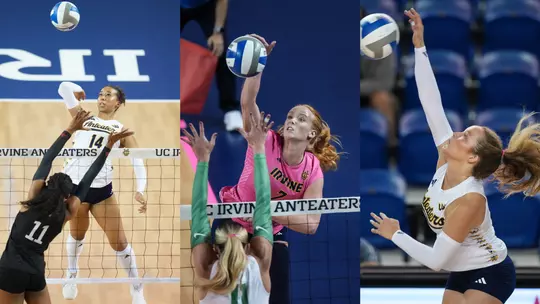
Injuries are an inevitable part of sports, but what separates good teams from great ones is how they respond. For UC Irvine women's volleyball, the last two years have tested the program's resilience in ways few could have anticipated. Three of the team's impact players – setter/opposite Jessica Bates, outside hitter Brianna Brewer, and veteran outside hitter Kendra MacDonald – have each battled through major knee injuries that cost them significant time on the court.
Collectively, their journeys have been defined not by the setbacks themselves, but by the faith, grit, and unwavering support systems that carried them through some of the toughest moments of their careers. Now, with all three working their way back, the Anteaters are finding their stride.
“I think one of the most inspiring parts of sports is a good comeback story,” 12th-year UCI head coach Ashlie Hain said. “We have several unfortunate injuries to three key players. To see them in the strength and training rooms working hard throughout the year is something you can't really put into words. It requires commitment and determination every day. There are a lot of hard days but I truly believe in these young women and their potential. They are three players with great character and integrity so when I see them back on the court I get chills because I am so proud of them.”
Trusting the Process
When Jessica Bates arrived on campus as a freshman in the fall of 2024, there were high expectations for the 5-foot-10 setter/opposite. She was the perfect addition to run a 6-2 system alongside 2023 Big West Freshman of the Year Nicole Feliciano, but in her first preseason match, Bates tore her ACL in her left knee. Although it was devastating for Bates, she was prepared for the next steps, as it wasn’t her first time. In high school, she tore her ACL in her right knee.
“I kind of already knew what to expect so my mindset shifted completely,” Bates said. “The first time, I was like why is this happening, but then the second time I was just positive about it and trying to take it day-by-day. I’m very religious so my faith is a huge thing that helped me get through it. I knew I had to trust God’s timing.”
Being prepared for what was to come didn’t make the next 11 months any easier. She knew the hard work that would be required during the recovery process, but it didn’t make her any less sore. Mentally, she was ready to slow everything down and tackle each day as it came, but that didn’t eliminate the negative thoughts from popping up, especially when challenges arose.
One setback came about seven months into her rehab. Every few weeks she was being tested on her strength and had been progressing on schedule, but this time her numbers went down, which was hard for Bates to hear because she had been feeling good.
“I felt strong but my test result didn’t show that; it was just defeating,” Bates said. “I had to regroup and remind myself that everything happens for a reason. I’m going to get to that point eventually, so I just have to stay in the moment and not try to think about the future. I had to continue to focus on the process and not the end result.”
Bates trusted that process and returned to the court in 2025. Unfortunately, after only seven matches played, in which she had two triple-doubles, a stress fracture in her foot kept her out for the rest of the season. Although she was sidelined once again, Bates continued to stay positive and show up for the team.
“When you’re going through something so tough, it’s easy to be internal,” Bates said. “I think something that helped me a lot was being external and knowing that even if I don’t feel the best, my team needs me. I wanted to be there for them. They had been there for me through this entire journey, so I owed it right back to them.”
Family is another big reason Bates has been able to manage and push through all the adversity over the last few years. Her twin brother, who plays baseball at George Fox University in Oregon, is her best friend and someone she talks to every day. He provides constant encouragement and helps her navigate the tough times, always knowing the right thing to say in the moment. Her father has also helped her re-evaluate her approach to being a Division I student-athlete by reminding her to work smarter, not harder.
Bates has always been a perfectionist, striving to master her craft in everything she does. In volleyball, that took a toll on her physically. This year, she is doing her best to listen to her father’s advice while also listening to her body. When she’s not feeling 100%, she knows she shouldn’t try to max out in the weight room and will need to work with her coaches and athletic trainer to manage her time on the court both at practice and in matches. For Bates, that has been a difficult adjustment, but something she understands will help her in the long run.
As she continues to work through her injuries, Bates has had her ups this year, including a season-best performance against Southeastern Louisiana where she had nine kills, 24 assists, and 21 digs. She’s also had her downs, missing five matches and seeing limited action in others. The lack of consistency has been frustrating for the tri-captain, but Bates continues to rely on patience, trust, and her faith to keep her grounded. Those three things have given her more peace of mind and gratitude during the challenging times.
“I’m super grateful to just be playing,” Bates said. “I have so much more gratitude now when I have the chance to play because it could be gone in the blink of an eye.”
Long-Awaited Debut
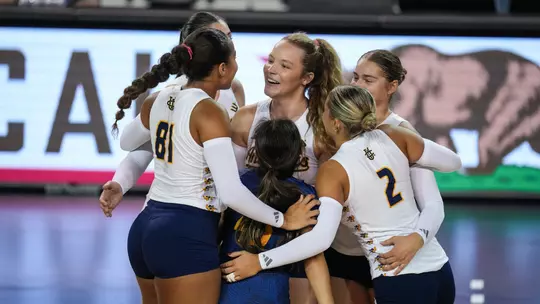
After suffering an ACL injury in each knee during her high school career, Brianna Brewer was ready for a fresh start at UC Irvine. She graduated from Rancho Cucamonga High School early and came to UCI in January 2025 to start her college courses and prepare for her freshman season in the fall. But Brewer, who was still recovering from her second ACL surgery, knew something was off.
She had come back on schedule following her first ACL tear as a freshman. The second time around Brewer was about 10 months into rehab and still couldn’t run or jump, so when she arrived in Irvine, she went to see the doctor. An MRI revealed a cyclops lesion – scar tissue buildup in the front of her knee – that was preventing her from bending her leg. It also showed a loose ACL and a meniscus that had not fully healed. She was given the option to just remove the cyclops lesion, or redo the whole process, repairing both the ACL and meniscus, while also getting rid of the scar tissue. After confirming with her doctor that she could still come back and play following another surgery, and knowing she had the support of her coaches, Brewer chose the latter.
“I was pretty devastated,” Brewer said. “It wasn’t the best news, but in the back of my mind, I knew something was wrong with my knee, so I was excited for the opportunity to get better and be able to come back. Then my coaches gave me the confidence by telling me they believed in me and that I had done it before so they knew I could do it again.”
Brewer sat out the 2025 season recovering from her third surgery, and her second in two years. It wasn’t how she planned to start her collegiate career, but it ended up helping her get acclimated to the next level both athletically and academically. Most incoming freshmen struggle with the transition from high school to college, but she was able to take everything in from the sideline. While she was watching and learning, she was also in the middle of the rehab grind.
With her coaches, teammates, and family, including her older sister who is a senior on the UC Riverside women’s volleyball team, rallying behind her, along with her own competitive nature, Brewer continued to show up in the weight room and at physical therapy every day. A fresh perspective also helped her take on each new challenge she faced.
“Having all these injuries made me realize there’s more to life than just volleyball,” Brewer said. “I stopped putting so much pressure on myself to have to do things, and it became more of me wanting to do it and wanting to get stronger every day.”
Even with the positive outlook, there were still times when Brewer needed others to lift her up. One of those times came earlier this year when she failed her strength test in the spring. The work she had been putting in didn’t show in the results. Thoughts of giving up flooded her mind, but everyone Brewer talked to encouraged her to stick with it.
“I remember I went to my car and just cried; I really felt like quitting,” Brewer said. “I called my dad and he just told me to keep trusting the process. He said if things didn’t work out by season, we could re-evaluate, but to remember how much I love the game. I also cried to my physical therapist, my athletic trainer, and our lifting coach, but they were all there for me and really helped me get through it.”
It was a difficult moment for Brewer, but she let her feelings and frustrations out, then got back on course. She rediscovered the belief in herself, which everyone else had in her from the beginning. A few months later, she was gearing up to make her long-awaited collegiate debut.
That debut was put on hold for a couple more weeks when she suffered a concussion in an exhibition match. After everything she had already overcome, it was a frustrating but minor setback for Brewer. She continued to cheer from the sideline for the first three matches of the year before finally stepping on the court in an Anteater uniform on September 3. In that match, Brewer made an immediate impact with 11 kills on .385 hitting against New Mexico State. She has continued to put up solid numbers but knows there is so much more she can give.
“Coming into this season, I was nervous but mostly excited because I knew I had put in so much work to come back, and I had waited so long,” Brewer said. “I’m really happy to be on the court and I’m so grateful for the opportunity to play volleyball. At the same time, I feel like I have so much more to improve on, so I’m just excited about getting better and being able to play how I used to.”
The Final Piece
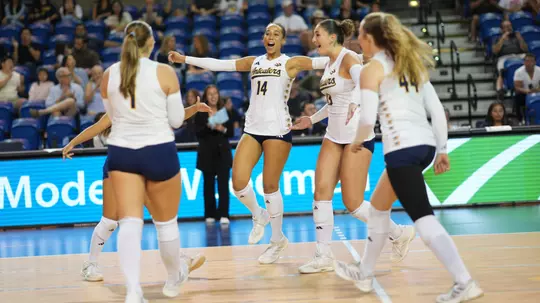
Kendra MacDonald made it through over a decade of playing volleyball without a major injury. That unfortunately changed on September 18, 2025.
MacDonald and the Anteaters were feeling good heading into the first match of their preseason Nashville trip. They were going back-and-forth with Lipscomb with the score tied at 13-13 in the first set. On the next play, MacDonald went up to hit a go ball – a low and fast set to the outside – and landed awkwardly on someone’s foot. She fell to the ground, screaming in pain. The rest of the gym went quiet.
Everyone who witnessed it knew right away the severity of the injury, including her parents, who were in the stands. Her teammates were crying with her because they all understood how much that year meant to their senior team captain.
MacDonald was transported to the hospital, where she found out it was a patella injury, which would require surgery and a long recovery. Although she wanted to stay to support her teammates in their next match at Vanderbilt, she listened to the advice of her athletic trainer and was joined by her mother for the long trip home.
MacDonald made it through the excruciating five-hour flight and went into surgery the next day. It had been a whirlwind 72 hours. It wasn’t until the pain started to subside that she began to process what had happened – her senior season was over.
“I feel like I’m still processing it,” MacDonald said. “Once that pain started to wear off a little more, I felt so isolated and out of my comfort zone. It was my fourth year on the team and these are my best friends, but now they’re off traveling to matches and I’m sitting at home doing nothing. It was rough for me because I’m always doing something.”
It didn’t take MacDonald long to find ways to keep busy as she started physical therapy the day after surgery. MacDonald is a very driven, self-motivated person, so she had already bought into the rehab process, but it wasn’t until later in November, when she decided to come back for a fifth year, that the intensity amped up. She also started applying to grad school at that time (she got into UCI’s Master of Management program), and took an internship with NextPlayU.
“I went back-and-forth with it,” MacDonald said of her decision to return. “I knew I had more left in the tank. Even if there were doubts and I knew it was going to be really hard, there was still something in me that really loved volleyball and I wasn’t ready to let that go.”
When you walk into the gym, it is easy to spot MacDonald. She is the one who is constantly encouraging and helping her teammates, and always has a smile on her face. Even though MacDonald is one of the most positive and driven people out there, the rehab process is a grind with its ups and downs.
“It wasn’t an easy mental health journey,” MacDonald said. “It’s difficult when you can’t really describe the little things you’re going through behind the scenes that no one sees, but I had Jessie and Bri to rely on through the process. There are hard battles you have to fight every day, and I could actually go to someone who understood. I could speak openly about it and that was a game changer.”
Similar to Bates and Brewer, MacDonald had her doubts after less-than-desirable strength test results. But again, she leaned into her support system that included her parents, older sister (who played volleyball at UCI from 2019-2022), teammates, coaches, and athletic trainers. MacDonald also discovered a shift in perspective was needed to fuel her comeback journey.
“I realized I needed to take some of the pressure off myself,” MacDonald said. “I told myself even if I’m not going to play this season, I’m going to give everything I have to the team with my voice and leadership. I just let my body kind of do its thing and in the meantime, tried to find ways to still give to the team.”
The body is an amazing thing and sure enough, MacDonald was cleared to make her season debut at UC Riverside on October 2, just over a year since her injury. The following night, she made a big impact at California Baptist, leading the Anteaters to a reverse sweep. She played in the final three sets and finished with seven kills. MacDonald provided the steady, veteran leadership that a young UC Irvine squad had been missing.
“I get goosebumps when asked about how it felt to get back on the court,” MacDonald said with a smile. “I was nervous against Riverside but quickly settled in that second match. I just felt a lot freer to swing and felt more like myself.”
The injury has changed MacDonald’s approach to volleyball. She knows she isn’t at the physical level she was at before, and may never get there, but watching the game from the sideline helped her to play smarter. She can anticipate better, being one step ahead of her opponent. It has also made her even more grateful for the opportunity to still be at UC Irvine, playing the sport that she loves.
“I love this place,” MacDonald said. “I’ve met all my best friends, and I have the best trainers and coaches. I’ve always been grateful, but I don’t take a day for granted anymore. And I don’t really care as much about my results, but more about giving everything I have.”

Back on Track
The road back was never a straight line for Bates, Brewer, or MacDonald. It was filled with setbacks, tears, and moments of doubt, but through their support systems and their own determination, they found a way forward – one day at a time.
That shared struggle has forged a bond that transcends the volleyball court, and that unity is showing up in the win column. UC Irvine has won seven of its last nine matches and is among the top three in the Big West standings. But the numbers only tell part of the story. The bigger victory has already been won – three young women who refused to quit, rediscovering their love for the game, and reminding everyone around them that the comeback is always worth the fight.